FriendCrib Mag
Skipping Tracks on a Portable CD Player
Portable CD players like the Sony Discman skipped whenever you walked too fast. Anti-skip memory and cassette adapters were the fixes.
 Written by Natalie Brooks · 56k: ~1 min
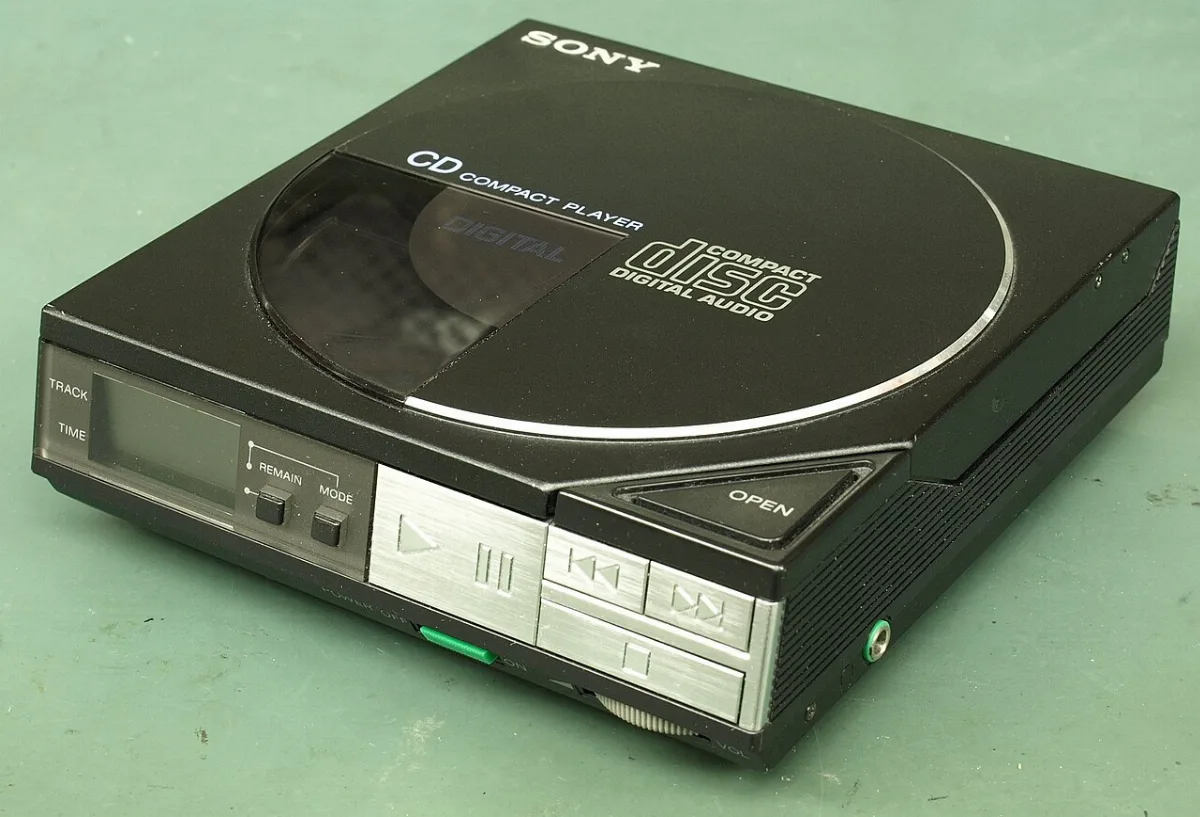
A portable CD player let you carry a whole album with you and play it through headphones, as long as you didn't bump it too hard. Sony started it with the D-50 Discman in November 1984, which cost about half as much as Sony's first home CD player. Discmans and other portable CD players stayed popular through the 1990s and early 2000s. People remember the skipping, the battery appetite and the backpack pocket where one lived next to a wallet full of CDs. Sony renamed its line the CD Walkman around 2000, and the players faded out as MP3 players and phones took over.
The first Discman
The D-50 was a big deal in 1984. CDs were brand new, and most CD players were large machines that sat on a shelf. Sony squeezed one down to roughly the size of a CD case, give or take. It sold for 49,800 yen in Japan, which worked out to about $350 at the time.
Early on, the name "Discman" wasn't even on the box everywhere. In North America the first model was sold as the D-5. Over time, though, Discman became the word people used for any portable CD player, the way people called every music player a Walkman.
Why did portable CD players skip?
Portable CD players skipped because the laser reading the disc lost its place when the player moved. CDs spin fast, and the laser has to follow a tiny track. A jolt from walking, jogging or riding the bus knocked it off for a moment, and the music stuttered or jumped. If you were walking, you learned to hold the player flat and steady, or to keep it in a jacket pocket where it didn't bounce.
Manufacturers fought back with anti-skip memory. Later players read a few seconds of music ahead and stored it, so a quick bump didn't interrupt the song. Sony called its version Electronic Shock Protection, usually shortened to ESP. Boxes started bragging about how many seconds of protection each player had, and people compared the numbers like horsepower.
Even with anti-skip, running with a Discman was a gamble. Most people saved it for sitting still, and a bus on a pothole road still won.
Why did a Discman eat so many batteries?
A Discman ate batteries because it had to spin a disc and run a laser at the same time. Most ran on AA batteries, and a long trip could drain a set before you got where you were going. People carried spares, borrowed from TV remotes and slowly learned that cheap batteries died fastest. Some players came with rechargeable batteries that clipped inside, while the very first D-50 had an optional pack that held a stack of larger batteries.
When the batteries got low, the song dragged and warbled like a record on the wrong speed, then cut out. Then it was silence until the next gas station.
Cassette adapters and the car
Most cars in the 1990s had tape decks, not CD players. The fix was a cassette adapter, a fake tape with a wire coming out of it. You put the tape in the car stereo, plugged the wire into your Discman, and your CD played through the car speakers. It sounded a little fuzzy, and the wire always got tangled, but it worked.

Sony even sold "car ready" Discman bundles that came with an adapter and a power plug for the cigarette lighter.

CD wallets and backpacks
You couldn't carry your whole collection, so you picked. A zip-up CD wallet with plastic sleeves held a dozen to a few dozen discs, and choosing which ones went in it was a serious decision. The jewel cases stayed home, and the booklets went missing.
Scratches were the enemy. One deep scratch could make a favorite track skip forever, and everyone had a trick for fixing it, from toothpaste to rubbing in circles with a T-shirt. The tricks worked about as well as you'd expect.
Plenty of those discs were mixes. If you spent nights writing track lists in Sharpie, you probably made half of them for your Discman.
The rise and fall of the Sony Discman. Watch on YouTube
Sharing one pair of headphones
A Discman was often a group activity. Two friends on a bus would split a pair of headphones, one earbud each, and lean in close so the wire reached. Whoever owned the player picked the album, and the other person got a vote only if they'd brought the spare batteries. Plenty of people heard a band for the first time this way, half a song at a time, on the way home from school.
MP3 CDs and the end of the line
In the early 2000s, some portable CD players learned to play MP3 CDs. A single burned disc could hold well over a hundred songs, which felt like magic. Sony's CD Walkman models also played ATRAC CDs, its own compressed format.
It didn't last. Players like the iPod held thousands of songs with no discs at all, and they didn't skip. Sony's portable CD players hung on for years, mostly as cheap players for people who still had big CD collections, and they were discontinued in the early 2010s.
The Discman rituals
Everyone had the same small habits, and most of them came with a reason.
| Habit | What it was for |
|---|---|
| Pressing the lid down | Making sure it was really closed |
| The hold switch | Keeping you from bumping the buttons |
| Foam headphones | Always half falling apart |
| Holding it flat on the bus | Treating it like a full cup of coffee |
| The anti-skip display | Counting seconds of memory |
| The backpack pocket | A CD wallet, a Discman and a tangle of wires |
Why people still miss it
A portable CD player made you choose. You brought one album, or a few, and you listened all the way through, track order and all. Plenty of people learned every word of an album because it was the only one they had that day, usually one they'd picked out at Tower Records.
If there's an album you wore out on a Discman, its best song belongs on your profile. Make a crib and set it as your song, then see who else knows every word.
Lid pressed shut, hold switch slid on, and the first track starting right where the album always did.
You Might Also Remember
 Wii Sports Bowling and the Living Room Tournament
 Whatever Happened to MySpace (and Tom)?
 How Did T9 Texting Work on Old Flip Phones?
 The Microsoft Zune Came in Brown
 MySpace Bulletins and the Surveys We All Reposted
 Homestar Runner and the Strong Bad Emails Everyone Quoted
 Tamagotchi and the Keychain Pets That Needed You at School
 Waiting a Week for Disposable Camera Photos
Put the song you played until the CD wore out on your crib.
Free, 18+ and no algorithm. Pick a profile song, rank your Top 8 and leave your friends comments.
Get Your Crib, It's Free